
Why Your EV Needs a 15m Type 2 Cable for Hard-to-Reach Spots
Why a 15m Type 2 EV Charging Cable Solves Your Hardest Charging Problems
A type 2 ev charging cable 15m is the longest standard portable charging cable most EV owners will ever need — and for a growing number of drivers, it’s the only length that actually works.
Quick answer: A 15m Type 2 EV charging cable is a Mode 3, Type 2-to-Type 2 cable that lets you charge any Type 2 EV or plug-in hybrid from a charge point up to 15 metres away. It comes in single-phase (up to 7.6kW) and three-phase (up to 22kW) versions, is rated for all-weather use, and is compatible with virtually every EV on UK and European roads.
Who needs one:
- Homes with long driveways where the charge point is far from the parking spot
- Shared or awkward parking bays where you can’t always park close to the charger
- Workplace or fleet settings with multiple bays and fixed charge point locations
- Public charging forecourts where the bollard isn’t next to your car
At a glance:
| Feature | Typical 15m Type 2 Cable |
|---|---|
| Connector type | Type 2 to Type 2 (IEC 62196) |
| Max power (single-phase) | 7.4kW – 7.6kW at 32A |
| Max power (three-phase) | 22kW at 32A |
| Weather rating | IP65 (when connected) |
| Temperature range | -30°C to +50°C |
| Durability | 10,000+ mating cycles |
| Warranty | 2 years (standard) |
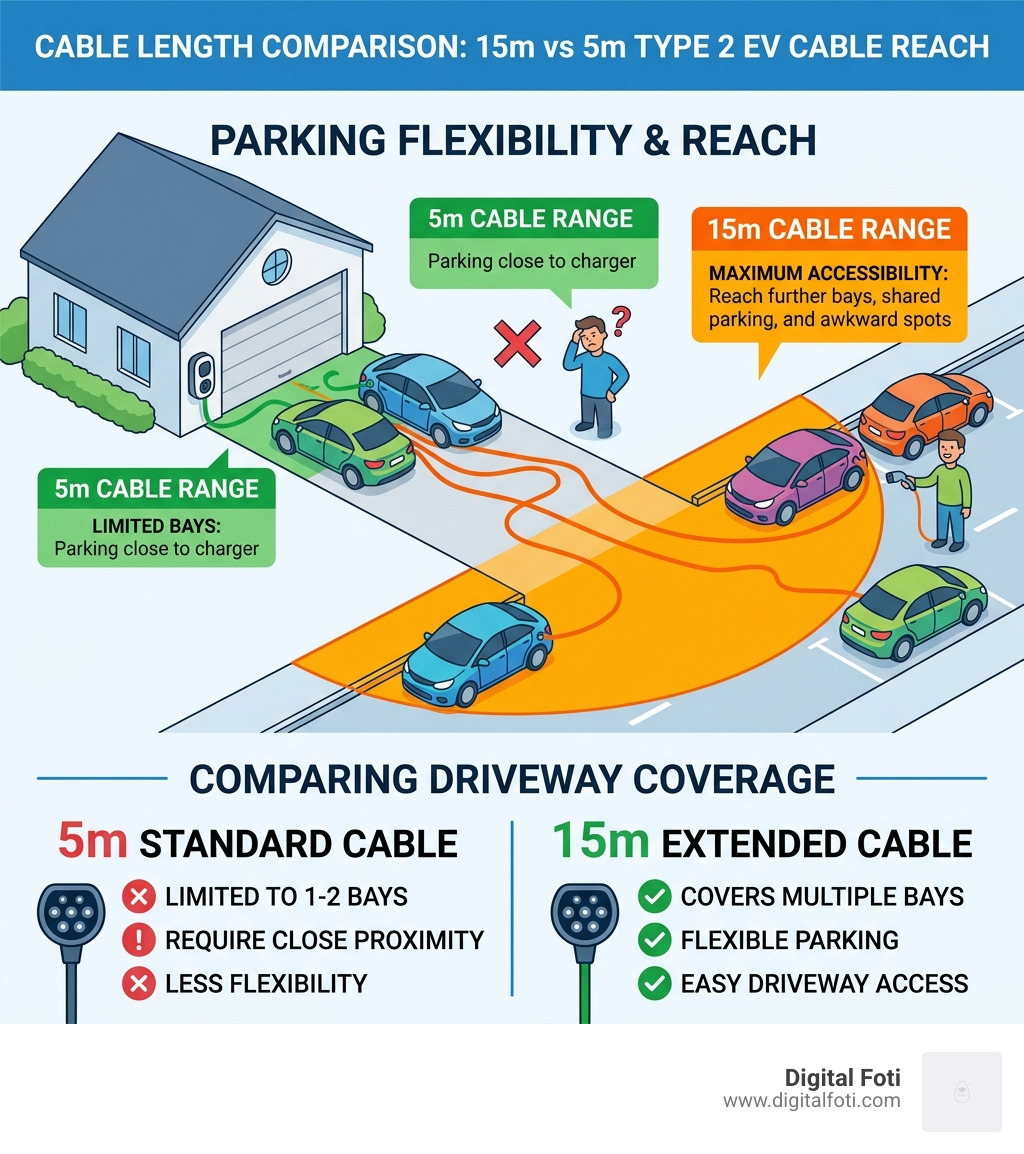
Most standard cables that come in the box with an EV — or bundled with a home wallbox — are 5m to 7.5m long. That’s fine for a garage next to the kerb. But the moment your parking spot is on the other side of the driveway, behind a gate, or in a shared bay, that short cable becomes a real problem.
A 15m cable doesn’t just add metres. It adds freedom to park where it’s practical, not where the charger happens to be.
Technical Specifications of a Type 2 EV Charging Cable 15m
When we look at the engineering behind a type 2 ev charging cable 15m, it is clear that these are not just longer versions of standard cables; they are heavy-duty pieces of infrastructure designed to handle significant electrical loads over a long distance.
Because the cable is 15 metres long, the quality of the internal copper and the outer insulation is critical. High-quality cables typically use TPU (Thermoplastic Polyurethane) sheathing. Unlike cheaper PVC or TPE, TPU remains incredibly flexible even when the temperature drops to -30°C, and it offers superior resistance to UV rays and oil.
The internal contacts are another area where quality matters. Premium cables feature silver-plated contacts. Silver is an excellent conductor and resists corrosion, which is vital for a cable that will likely spend its life outside in the British or European weather.
| Specification | 7.4kW Single-Phase | 22kW Three-Phase |
|---|---|---|
| Max Current | 32A | 32A |
| Voltage | 230V – 250V AC | 400V – 480V AC |
| Phases | 1 Phase | 3 Phase |
| Material | High-grade TPU | High-grade TPU |
| Ingress Protection | IP65 (Mated) | IP65 (Mated) |
| Impact Rating | 2-ton run-over proof | 2-ton run-over proof |
For those with a three-phase supply at home or work, the 15m 22kW EV Charging Cable Type 2 32A Extra Long is the gold standard, providing the maximum possible AC charging speed for compatible vehicles.
Choosing Between Single-Phase and Three-Phase Type 2 EV Charging Cable 15m
Choosing the right phase for your type 2 ev charging cable 15m depends on two things: your vehicle’s onboard charger and the power supply available at your charging point.
- 7.4kW / 7.6kW Single-Phase: This is the most common choice for UK households. Most home wallboxes are single-phase 32A. A single-phase 15m cable is lighter and easier to coil than a three-phase version. If your car (like many plug-in hybrids or older EVs) only accepts 7kW, this is all you need.
- 22kW Three-Phase: If you have a three-phase charger (common in workplaces and newer public stations) and a car that can handle it (like a Renault Zoe, some Teslas, or Audi e-trons), this cable can deliver up to 120km of range per hour of charge.
Pro Tip: A 22kW cable is “backward compatible.” You can use a three-phase cable on a single-phase charger, and it will safely work at the lower speed. However, a single-phase cable cannot “unlock” three-phase speeds. If you want a future-proof setup, the 15m Type 2 EV Charging Cable – 7 kW Single-Phase (Blue) is an excellent, highly visible choice for standard home use.
Maximizing the Lifespan of Your Type 2 EV Charging Cable 15m
A 15m cable is a significant investment, so we want to make sure it lasts. These cables are rated for approximately 10,000 mating cycles. That means if you plug and unplug it every single day, it should last over 25 years!
To reach that lifespan, a little maintenance goes a long way:
- Pin Inspection: Every few months, look inside the connector heads. Ensure there is no debris, dirt, or signs of “arcing” (black marks on the pins).
- Use Dust Caps: Always replace the rubber dust caps when the cable isn’t in use. This prevents moisture from getting into the sensitive terminals.
- Avoid Kinks: While TPU is flexible, try not to leave the cable with sharp bends or heavy items stacked on top of it for long periods.
For those looking for a robust, certified option, the 15m Black Type 2 EV Cable | 22kW 3-Phase | UKCA Certified offers the durability needed for daily high-power charging.
Compatibility and Practical Use Cases for Extra-Long Cables

One of the most common questions we get at Digital Foti is: “Will this 15m cable work with my car?” The answer is almost certainly yes. The Type 2 (Mennekes) connector is the universal standard for AC charging in the UK and Europe.
Whether you drive a Tesla Model 3, an Audi e-tron, a BMW iX3, or a Jaguar I-Pace, a type 2 ev charging cable 15m will fit perfectly. It also works with modern Type 2 plug-in hybrids (PHEVs).
Where the 15m length really shines:
- Long Driveways: If your charger is mounted on the front of your house, but you prefer to park your car further down the drive or behind a second vehicle, 15 metres gives you the reach you need.
- Shared Parking: In apartment complexes or shared office car parks, you might not always get the spot right next to the charger. This cable ensures you don’t have to play “musical chairs” with your neighbours.
- Commercial Forecourts: Some public charging bays are designed poorly, or a non-EV might be “ICE-ing” the spot closest to the charger. A long cable lets you reach from the next bay over.
- Fleet Bays: For businesses with multiple vans or cars, a 15m cable allows one central charging hub to serve several vehicles without moving them.
Safety Standards and Material Durability
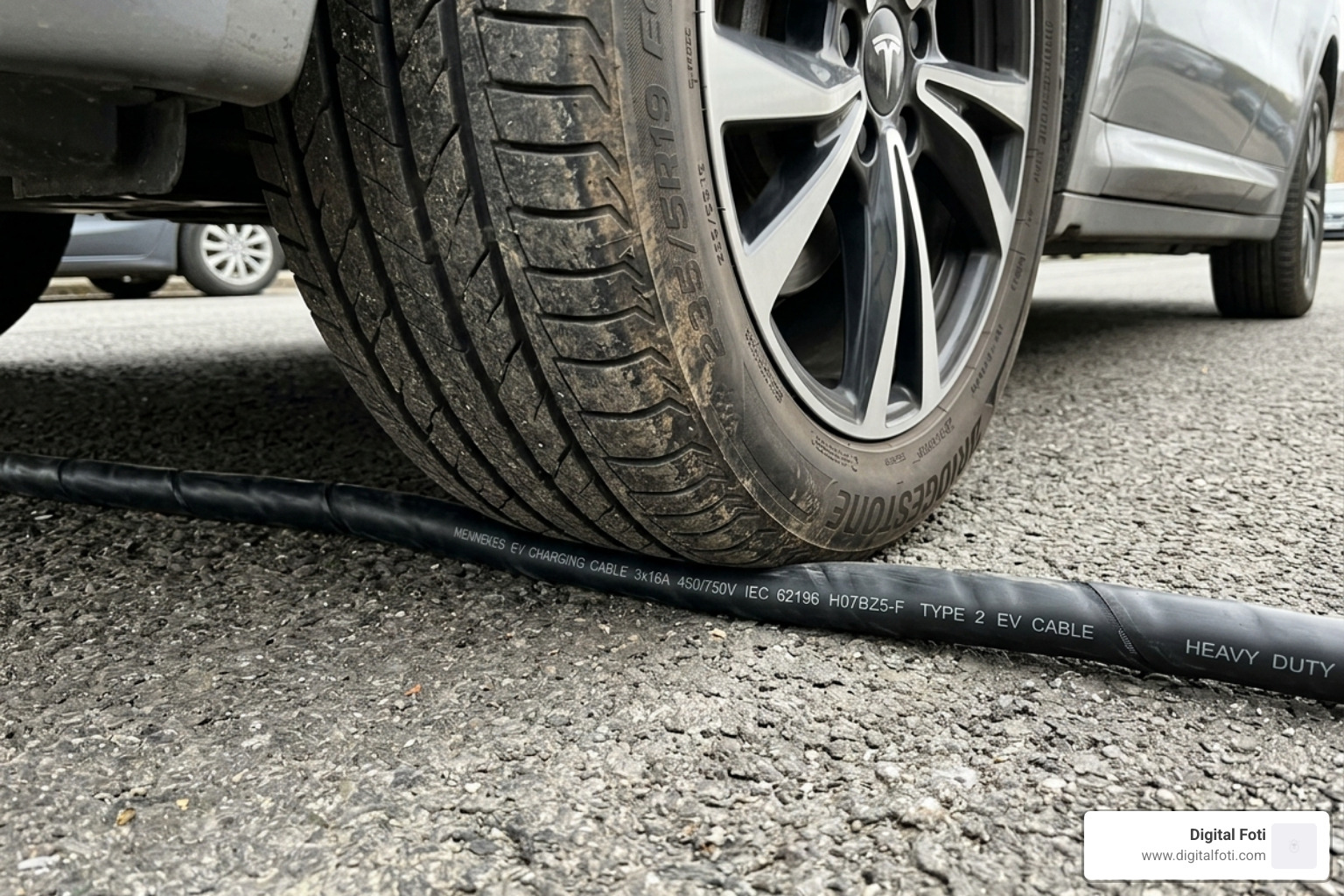
Safety is paramount when dealing with high-voltage electricity. A high-quality type 2 ev charging cable 15m undergoes rigorous testing to meet international standards. When shopping, always look for these certifications:
- UKCA & CE: Ensures the product meets UK and European safety, health, and environmental requirements.
- TUV & RoHS: Certified for quality and the absence of hazardous substances.
- IEC 62196: The international standard for EV plugs and sockets. You can read more about it here: IEC 62196.
Durability is just as important as electrical safety. Premium 15m cables are designed to be “run-over proof” up to 2 tons. While we don’t recommend making a habit of driving over your cable, it’s comforting to know that if a delivery van clips it, the cable won’t instantly fail. They are also drop-tested from a height of 1 metre onto concrete to ensure the connector heads don’t crack.
The operating temperature range is usually between -30°C and +50°C. This means whether you’re charging in a Scottish winter or a Mediterranean summer, the internal components remain protected and the cable remains flexible.
Why a Type 2 EV Charging Cable 15m is Not an Extension Lead
This is a critical safety point: You should never use an EV charging cable as an extension lead.
Standard EV cables are designed to go directly from the charging station (EVSE) to the car. They are not designed to be “daisy-chained” together. Here is why:
- Voltage Drop: The longer the cable, the more resistance the electricity faces. Extending a cable beyond its manufactured length can cause a significant drop in voltage, leading to inefficient charging.
- Heat Buildup: Connections between two cables are points of high resistance. This can cause the plugs to overheat, potentially melting the plastic or causing a fire.
- Communication Errors: EV charging involves a “handshake” between the car and the charger via a pilot wire. Adding an extension can disrupt this signal, causing the car to refuse the charge.
- Safety Risks: Extension leads often lack the IP65 weatherproofing of a single, continuous 15m cable, making them dangerous in the rain.
If you need 15 metres of reach, buy a dedicated type 2 ev charging cable 15m rather than trying to extend a 5m cable.
Maintenance and Storage for Long-Reach Cables
Managing 15 metres of cable can be a bit of a workout if you don’t have a system. Because the cable is thicker and heavier than standard lengths (often weighing around 5kg to 10kg depending on the phase), storage is key.
Coiling and Strapping: We recommend coiling the cable in large, loose loops. This prevents the internal copper wires from twisting or straining. Many 15m cables come with a free storage bag or a carry strap. Using a carry strap is a game-changer; it keeps the bundle tight so it doesn’t unravel in your boot.
Drying Procedures: If you’ve been charging in the rain, don’t just throw the wet cable into a sealed bag. When you get home, wipe the cable down with a dry cloth and leave it in a well-ventilated area for a few hours. This prevents mould growth and ensures that moisture doesn’t seep into the connector heads over time.
UV Resistance: While TPU is UV resistant, leaving any cable in direct, scorching sunlight for months on end isn’t ideal. If you have a permanent outdoor setup, try to store the cable in a shaded box or under a cover when not in use.
Frequently Asked Questions about 15m EV Cables
Can I use a 15m Type 2 cable in heavy rain?
Yes, absolutely. High-quality 15m cables are rated IP65. This means they are protected against dust and low-pressure water jets from any direction. As long as the cable is “mated” (plugged into the car and the charger), it is perfectly safe to use in a downpour. Just ensure you don’t leave the ends sitting in a deep puddle of water.
Will a 15m cable slow down my charging speed?
In theory, longer cables have slightly more resistance, but in practice, a well-engineered type 2 ev charging cable 15m is designed with thicker copper cores to compensate for this. As long as you are using a 32A rated cable on a 32A charger, you will not notice a meaningful difference in charging speed compared to a 5m cable.
Is a 15m cable compatible with all Type 2 plug-in hybrids?
Yes. The Type 2 standard is universal. Whether you have a full battery-electric vehicle (BEV) or a plug-in hybrid (PHEV), the cable will work. Most PHEVs charge at a slower rate (usually 3.7kW or 7kW), and the cable will automatically adjust to the maximum speed your car’s onboard charger can handle.
Conclusion
At Digital Foti, we believe that technology should make your life easier, not more complicated. For many EV owners, the “standard” cable length is a constant source of frustration, requiring precision parking or awkward maneuvers just to reach the socket.
Investing in a type 2 ev charging cable 15m is one of the simplest ways to upgrade your EV experience. It provides the flexibility to park where you want, the durability to withstand the elements, and the safety of a certified, direct connection. Whether you are navigating a long driveway or a busy workplace car park, 15 metres of reach ensures you are never left out of range.
For more tech tips for a smarter digital life, including the latest in EV infrastructure and accessory guides, visit us at Digital Foti. We are here to help you navigate the transition to electric driving with confidence and ease.
